


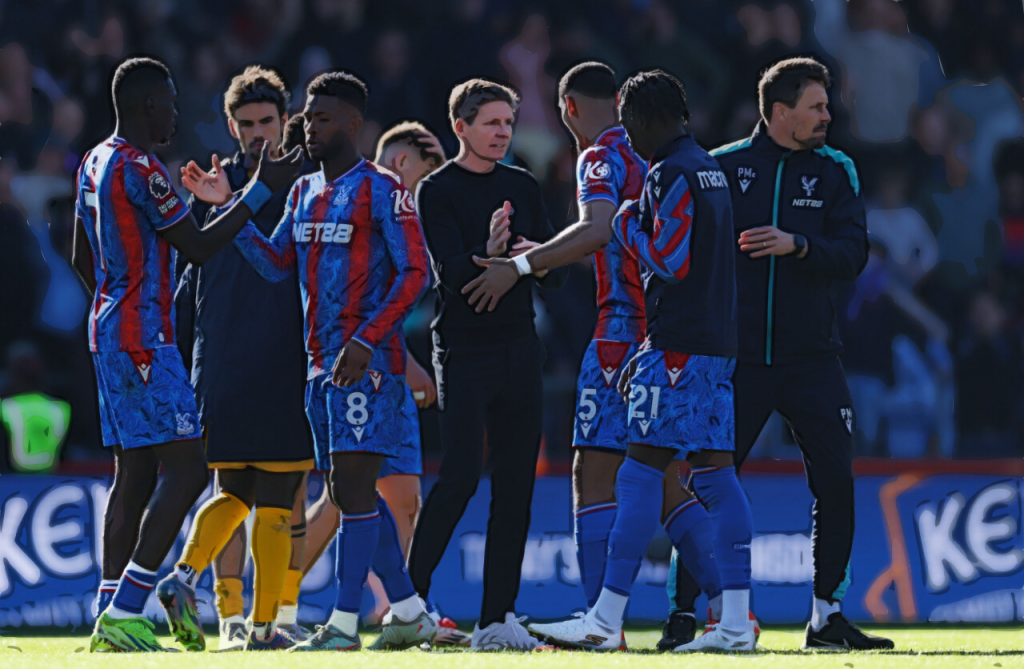
The final whistle at Selhurst Park on April 5th, 2025, signaled more than just a hard-fought 2-1 victory for Crystal Palace over Brighton & Hove Albion. It punctuated a remarkable display of resilience, tactical discipline, and sheer will to defend, particularly in the chaotic final minutes that saw Oliver Glasner’s side reduced to nine men while clinging onto a precious lead. In a Premier League landscape where defensive frailties can be ruthlessly punished and mental fortitude often proves the dividing line between success and failure, Crystal Palace’s improbable triumph offers a compelling blueprint. For a club like Manchester United, a side undergoing significant transition and aiming to cultivate a steely resolve, the lessons gleaned from Palace’s “united fortress” mentality in the face of adversity are particularly pertinent.
The narrative of the match was one of shifting momentum and escalating drama. Crystal Palace, eager to build on a six-game unbeaten streak in all competitions, started with intent, Daichi Kamada stepping into the lineup in place of Nathaniel Clyne as Jefferson Lerma shifted into defence. The home crowd at Selhurst Park were barely settled when, in the third minute, a lovely threaded pass from Eberechi Eze sliced through the Brighton lines to find Jean-Philippe Mateta inside the box. The French forward, displaying composure and clinical finishing, smashed a left-footed shot into the top right corner, giving Palace an early and deserved lead.
The early goal ignited Selhurst Park, and Palace continued to press, Eze himself coming close to doubling the advantage shortly after. However, Brighton, despite their recent away form which had seen five wins in seven matches in all competitions, gradually clawed their way back into the contest. In the 14th minute, Brighton threatened, forcing a brilliant double save from Palace’s Dean Henderson, who first tipped away Carlos Baleba’s low drive before reacting instantly to deny Danny Welbeck from close range.
Brighton’s persistence eventually paid off in the 31st minute. A decent ball from Yankuba Minteh on the right flank found Welbeck at the back post, and the striker made no mistake, sliding the ball past Henderson from close range to level the score. Despite the equalizer, Palace remained resolute, ensuring the score remained 1-1 heading into the interval.
The second half saw Palace regain the initiative. Ten minutes after the restart, in the 55th minute, Eze once again proved the catalyst, leading a swift counter-attack before finding Daniel Muñoz on the right side of the box. The Colombian full-back, with a composed finish, drilled a low right-footed shot across Brighton goalkeeper Bart Verbruggen and into the bottom left corner, restoring Palace’s lead. This goal, Muñoz’s fourth Premier League strike of the season, would ultimately prove to be the winner, but the drama was far from over.
The final quarter of the match descended into a tense and ultimately chaotic affair. In the 68th minute, substitute Eddie Nketiah, who had come on for Mateta just six minutes prior, went down in the Brighton penalty area under a challenge, but the referee deemed it a simulation and brandished a yellow card. Ten minutes later, in the 78th minute, Nketiah received his marching orders for a second yellow card following a high challenge on Brighton’s Jan Paul van Hecke. This left Palace to navigate the final minutes, including a significant amount of added time, with just ten men.
However, the numerical disadvantage was compounded further in the 90th minute when Palace captain Marc Guéhi was also shown a second yellow card for a late challenge on Brajan Gruda. With 12 minutes of added time announced, Palace were faced with the daunting task of defending a one-goal lead with only nine players against a determined Brighton side.
What followed was a remarkable demonstration of defensive fortitude. Despite the significant numerical disadvantage, Crystal Palace, under the guidance of Oliver Glasner, dug deep, showcasing an unwavering commitment to protecting their goal. The remaining defenders, including Jefferson Lerma, and the midfielders who dropped deeper, formed a compact and organized unit, frustrating Brighton’s attempts to break them down. Brighton, themselves reduced to ten men in the dying moments when Van Hecke received a second yellow card for a foul on Kamada, threw everything forward in search of an equalizer.
However, Palace’s nine-man rearguard held firm. Dean Henderson, who had already made crucial saves earlier in the match, produced a brilliant late save in the 102nd minute to deny Yasin Ayari a dramatic equalizer from close range. Blocks were made, clearances were crucial, and a collective spirit of resilience permeated the entire team. Even when Brighton managed to create opportunities, Palace found a way to thwart them, epitomized by Henderson’s heroic intervention.
This dramatic victory, completing Crystal Palace’s first league double over Brighton since 1933 and their first ever in the top flight, was built on more than just individual brilliance. It was a testament to the team’s underlying structure, their tactical adaptability in the face of adversity, and the unwavering mental strength they displayed when the odds were heavily stacked against them.
For Manchester United, a club that has at times struggled for consistency and resilience, particularly in defensive phases, the lessons from Crystal Palace’s performance are manifold. While Manchester United secured a clean sheet in their recent derby against Manchester City, ending a run of eight home league matches without one, the overall defensive stability and mental fortitude required to consistently grind out results have been areas for improvement.
Examining Palace’s nine-man defense reveals several key aspects that Manchester United could look to emulate:
- Organizational Discipline: Even with two players less, Palace maintained a discernible defensive shape, limiting the spaces Brighton could exploit. This level of organizational discipline, particularly under pressure, is crucial. Manchester United, even with a full complement of players, have sometimes appeared disjointed defensively, leaving gaps for opponents to capitalize on. Practicing and instilling a deep understanding of defensive roles and responsibilities, adaptable to various game states including numerical disadvantages, could be invaluable.
- Individual Responsibility and Work Rate: Every Palace player, even those in attacking roles, understood their defensive duties in the final minutes. They tracked back, made tackles, and put their bodies on the line to block shots. This collective work ethic is non-negotiable when defending with a numerical disadvantage. For Manchester United, cultivating a similar level of unwavering commitment from every player, regardless of their primary position, would significantly enhance their defensive solidity.
- Goalkeeping Prowess as a Foundation: Dean Henderson’s performance, culminating in the crucial late save, highlighted the importance of a reliable goalkeeper in such situations. A commanding presence and the ability to make match-winning saves can be the bedrock of a resilient defense. While Andre Onana has shown glimpses of his quality for Manchester United, consistency and commanding performances in high-pressure moments are vital attributes that can inspire confidence throughout the defensive unit.
- Mental Fortitude and Communication: Defending with nine men for an extended period requires immense mental strength. Palace’s players remained focused, communicated effectively, and displayed an unyielding determination to see out the victory. This mental resilience, the ability to withstand pressure and maintain focus despite adversity, is a crucial ingredient for any successful team. Manchester United, often under intense scrutiny, could benefit from fostering a similar level of mental toughness and clear communication within their defensive ranks.
While Manchester United’s tactical approach under Ruben Amorim, with their total of 37 Premier League goals this season being among the lowest in the top flight, has shown a focus on defensive solidity in certain moments, the capacity to maintain that resilience consistently, especially when facing unexpected challenges like red cards or periods of intense pressure, needs further development.
Crystal Palace’s victory against Brighton, secured against the odds with nine men, serves as a powerful reminder that defensive resilience is not solely about individual talent; it is a collective effort built on organizational discipline, unwavering work ethic, crucial individual contributions, and an unbreakable mental fortitude. As Manchester United strive to build a team capable of competing at the highest level, the lessons from Selhurst Park – the blueprint for a true “united fortress” – offer valuable insights into the essential qualities required to achieve sustained success. The spirit and determination displayed by Crystal Palace in those dramatic final minutes are qualities that any aspiring team, including Manchester United, would do well to internalize and strive to replicate in their own pursuit of building a formidable and resilient defense.