


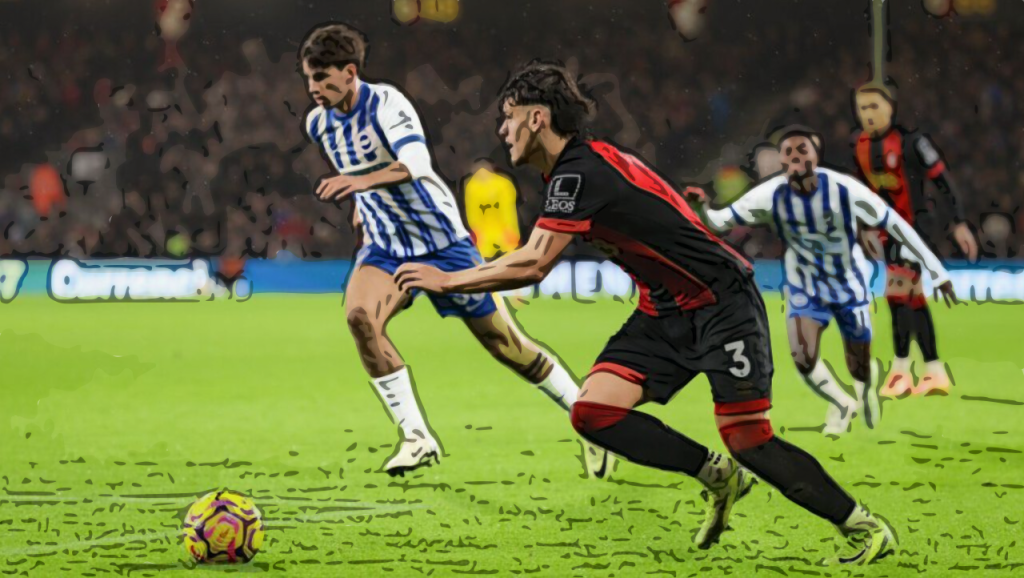
In the ever-evolving landscape of the Premier League, tactical flexibility has become a non-negotiable asset for any team with ambitions of challenging for the top honors. The ability to adapt formations, strategies, and personnel based on the opponent and game situation can be the difference between a hard-fought victory and a frustrating defeat. A recent match between Brighton & Hove Albion and AFC Bournemouth serves as a compelling case study in tactical adaptability, offering valuable lessons for Manchester United as they strive to become a more versatile and unpredictable force.
The contest between Brighton and Bournemouth, which saw Brighton secure a 2-1 victory, showcased the tactical nuances employed by both managers. Both teams demonstrated the capacity to shift formations, adjust their attacking and defensive approaches, and make shrewd in-game substitutions to gain a competitive edge.
Brighton and Bournemouth: A Tactical Chess Match
The match between Brighton and Bournemouth was a fascinating tactical battle, with both teams demonstrating a willingness to deviate from their established game plans.
- Brighton’s Fluidity: Under the guidance of their manager, Brighton have become renowned for their fluid attacking play and tactical versatility. In the match against Bournemouth, they showcased their ability to seamlessly transition between a 4-2-3-1 and a 3-4-3 formation, depending on the phase of play and the opponent’s defensive setup.
- Bournemouth’s Adaptability: Bournemouth, under their manager, have also displayed a growing tactical awareness. In this match, they initially adopted a compact 4-4-2 formation, aiming to stifle Brighton’s attacking forays through the middle. However, as the game progressed, they shifted to a more expansive 4-3-3, seeking to exploit the flanks and stretch Brighton’s defense.
Learning Points for Manchester United: Embracing Tactical Versatility
Manchester United’s current tactical approach can, at times, appear rigid and predictable. To unlock their full potential, Manchester United must embrace greater tactical flexibility, drawing inspiration from the adaptability showcased by teams like Brighton and Bournemouth.
- Developing a Versatile Tactical Approach: Manchester United’s manager must cultivate a tactical framework that allows for seamless transitions between different formations and strategies. This requires a deep understanding of the squad’s strengths and weaknesses, as well as the ability to anticipate and react to the opponent’s tactical adjustments.
- Making Effective In-Game Adjustments: The manager must be proactive in making in-game adjustments, whether it’s a change of formation, a tactical tweak, or a personnel substitution. These adjustments should be based on a clear assessment of the game’s dynamics, aiming to exploit the opponent’s vulnerabilities and capitalize on emerging opportunities.
- Promoting Player Versatility: It is crucial to have players who are comfortable playing in multiple positions and formations, enabling Manchester United to switch tactics seamlessly during matches.
Versatile Formations: A Foundation for Tactical Flexibility
A key component of tactical flexibility is the ability to seamlessly transition between different formations. Manchester United should prioritize developing a repertoire of formations that can be effectively deployed based on the opponent and game situation.
- 4-2-3-1: A balanced formation that provides both defensive stability and attacking options, the 4-2-3-1 allows Manchester United to control the midfield, exploit the flanks, and support a lone striker.
- 4-3-3: An attacking formation that emphasizes wing play and high pressing, the 4-3-3 can be particularly effective against teams that sit deep and look to counter-attack.
- 3-5-2: A more defensive-minded formation that prioritizes central compactness and counter-attacking opportunities, the 3-5-2 can be useful against strong attacking teams or when looking to protect a lead.
Players Who Can Play Multiple Positions
Having players who can slot into different positions is beneficial to switching tactics easily during matches.
The Importance of Personnel: Versatile Players, Adaptable Tactics
Tactical flexibility is not solely dependent on formations and strategies; it also requires players who are comfortable operating in multiple positions and adapting to different roles. Manchester United must prioritize the development and recruitment of versatile players who can seamlessly slot into various tactical setups.
- Defenders: Players like can play in multiple defensive positions, providing tactical flexibility at the back.
- Midfielders: Midfielders who are capable of playing as holding midfielders, box-to-box midfielders, or attacking midfielders can offer a range of tactical options.
- Attackers: Attackers who can play as centre-forwards, wingers, or attacking midfielders can provide Manchester United with greater flexibility in the final third.
Reading the Game: Anticipating and Reacting to Opponent Adjustments
Tactical flexibility is not merely about implementing a pre-determined game plan; it’s also about the ability to read the game, anticipate the opponent’s adjustments, and react accordingly. Manchester United’s manager and players must develop a keen understanding of tactical nuances and the ability to identify and exploit emerging opportunities.
- Identifying Tactical Shifts: Players should be trained to recognize subtle changes in the opponent’s formation, pressing patterns, and attacking approach.
- Communicating Effectively: Players should communicate effectively with each other on the pitch, relaying information about the opponent’s tactical adjustments and suggesting potential countermeasures.
- Making Informed Decisions: Players should be empowered to make informed decisions on the pitch, based on their understanding of the game’s dynamics and the team’s tactical objectives.
Case Studies in Adaptability: Lessons from Brighton and Bournemouth
Analyzing specific examples from the Brighton-Bournemouth match can provide valuable insights into the practical application of tactical flexibility.
- Brighton’s Midfield Adjustment: Faced with Bournemouth’s compact midfield, Brighton adjusted their midfield positioning to create more space and passing lanes. They achieved this by dropping one of their central midfielders deeper to draw out a Bournemouth midfielder, while simultaneously pushing their full-backs higher to provide width and stretch the opponent’s defense.
- Bournemouth’s Attacking Shift: Recognizing that their initial 4-4-2 formation was struggling to create attacking opportunities, Bournemouth shifted to a 4-3-3, introducing an additional attacker and instructing their wingers to play higher and wider. This change stretched Brighton’s defense, creating more space for Bournemouth’s midfielders to operate and increasing their attacking threat.
- Late Game Substitution: Danny Welbeck produced the decisive goal as Brighton introduced him as a substitute.
Conclusion: Embracing Change, Maximizing Potential
Tactical flexibility is no longer a luxury; it’s a necessity for any team with aspirations of competing at the highest level. By embracing a more versatile tactical approach, developing players who are comfortable in multiple positions, and cultivating a culture of adaptability and in-game awareness, Manchester United can unlock their full potential and become a more formidable force in the Premier League. The lessons learned from matches like Brighton vs. Bournemouth offer a valuable roadmap for Manchester United as they embark on their journey towards tactical evolution.