
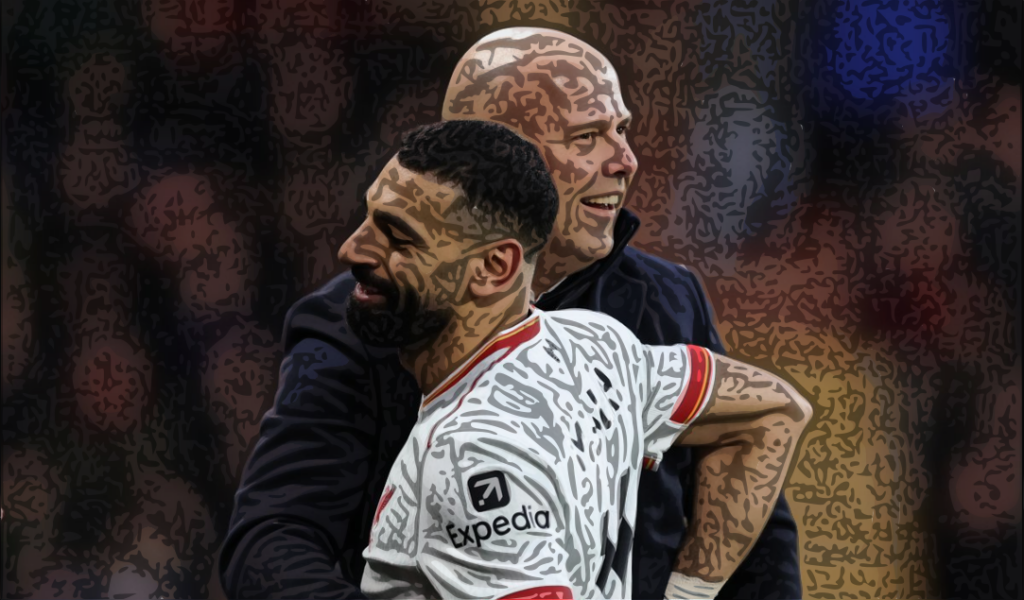
In the unforgiving world of the Premier League, where margins are razor-thin and opportunities often fleeting, the ability to convert chances into goals is the currency of success. For Manchester United, the glaring absence of a consistent, clinical finisher has become an increasingly costly deficiency. As the season progresses, the contrast between United’s profligacy in front of goal and the ruthless efficiency of players like Liverpool’s Mohamed Salah and Crystal Palace’s Jean-Philippe Mateta has become stark. This analysis delves into Manchester United’s striker conundrum, examining what they can learn from the likes of Salah and Mateta, and the urgent need to address this crucial area of their squad.
The Ruthless Efficiency of Mohamed Salah
Mohamed Salah’s performance for Liverpool against Bournemouth serves as a masterclass in the art of finishing. In a hard-fought 2-0 victory, Salah’s two goals not only secured the three points for his team but also underscored his status as one of the Premier League’s most reliable goalscorers. His first goal, a penalty earned after Cody Gakpo was tripped in the box, was converted with the kind of composure that Manchester United has desperately lacked this season. Salah’s penalty, a low shot into the bottom-right corner, was a testament to his focus and technique under pressure. This was not a hopeful punt; it was a precise execution of a skill he has honed to perfection.
Salah’s second goal highlighted his ability to create something out of seemingly nothing. With 15 minutes left in the match, he unleashed a curling finish from the right side of the area, sending the ball into the far corner of the net. This goal was not about brute force, but about skill, timing, and the capacity to find space where none appeared to exist. His ability to consistently find the back of the net, time and time again, sets him apart and makes him such a valuable asset.
Salah’s performance is not an anomaly, but rather an illustration of a consistent ability to score, as he has now surpassed the 20-goal mark in five different Premier League campaigns. Only Alan Shearer, Sergio Aguero, and Harry Kane have achieved this feat on more occasions. This record of consistency is what makes Salah a lethal threat, and it is precisely this kind of reliability that Manchester United is missing.
Manchester United’s Struggles in Front of Goal
In contrast, Manchester United’s match against Crystal Palace laid bare their struggles in the final third. Despite creating several promising chances, they failed to find the back of the net, ultimately succumbing to a 2-0 defeat. United’s inability to convert opportunities is not a new issue but a recurring theme that has plagued them throughout the season. The game against Palace highlighted the stark contrast between their build-up play and their finishing. While United managed to create openings, their efforts were either thwarted by a resolute Palace defense or by their own lack of precision.
A telling statistic underscores this deficiency: Manchester United has failed to score in the first half of a Premier League match 18 times this season. This consistent inability to establish early leads has often left them chasing games and struggling to break down stubborn defenses. The fact that they can create openings, but lack the finishing touch, is a clear sign that a significant overhaul of the attacking strategy is needed.
The Clinical Edge of Jean-Philippe Mateta
Crystal Palace’s Jean-Philippe Mateta, like Salah, exemplified the clinical edge that Manchester United desperately needs. His brace against United was a display of opportunism and effectiveness. Mateta’s first goal came from a rebound, bundling the ball into the net after Palace’s initial effort hit the crossbar. This goal demonstrated his awareness and knack for being in the right place at the right time, qualities that often separate good strikers from great ones.
His second goal was the result of a swift counter-attack, neatly slotting home a low cross to seal the victory for Palace. This strike highlighted his composure and ability to finish decisively when presented with an opportunity. Mateta’s goals underscored a key difference between the two sides that day: Palace capitalized on their chances, while United failed to convert theirs.
Mateta’s performance was not a fluke; it was a display of the kind of predatory instinct that United lacks. He showed an understanding of how to exploit defensive vulnerabilities and how to make the most of the opportunities that come his way. The fact that Mateta was able to score twice when United struggled to register a single goal is a stark reminder of the level of clinical finishing required at the highest level.
The Impact of Tactical Decisions
Ruben Amorim’s decision to not start with a recognized striker against Crystal Palace further highlighted the striker issue at the club. The choice to deploy Kobbie Mainoo as a “false nine”, while not inherently flawed, underscored the lack of reliable options available. Despite Mainoo linking up well with Alejandro Garnacho to create early openings, United struggled to convert those chances. This tactical decision also underscores the current lack of a consistent striker, which has forced the coach to seek alternatives rather than playing a proven goalscorer in his system.
While tactical flexibility is an asset, the lack of a specialist striker capable of consistently finding the net is a glaring weakness. This has forced United to approach games with a makeshift frontline, often lacking the focal point that a top striker provides. Amorim’s decision to leave Rasmus Hojlund and Joshua Zirkzee on the bench, whilst possibly tactical, is a clear signal of the problems that the club has in finding a reliable goal-scorer.
Learning From Liverpool’s Approach
Liverpool’s successful deployment of Salah offers a valuable template for Manchester United. Salah’s consistent goal-scoring output is not solely due to individual brilliance; it is also a result of the team’s tactical approach, which is designed to create opportunities for him. Liverpool’s system emphasizes quick transitions, incisive passes, and the use of wide areas to create space for Salah to operate. This tactical structure has enabled Salah to flourish, consistently providing the team with crucial goals.
Manchester United must learn from this approach and create a tactical system that plays to the strengths of their attackers. This may involve making structural changes and bringing in new players who fit into this new style, or it may involve developing a system for current players to learn to play in a more efficient way.
The Way Forward
The conclusion is inescapable: Manchester United must prioritize finding a reliable goalscorer who can consistently convert chances. Whether through a new signing or the development of existing talent, this is the most pressing need if the club is to compete for top honors. The club must look to players like Salah and Mateta and look at how they have developed their game to better understand what is needed to become a clinical striker.
- Recruitment: The club must make a concerted effort to scout and recruit strikers who possess not just raw talent but also the requisite composure, technique, and killer instinct in front of goal. The recruitment team must look for players who can react in the same way that Mateta did in his two goals, and who can consistently find the back of the net like Salah.
- Tactical Re-evaluation: The coaching staff must also re-evaluate their tactical setup to create more opportunities for their strikers. This may involve adjusting the team’s style of play to better utilize the skills of their attackers, and it may include studying how other successful teams, like Liverpool, get their goals.
- Individual Development: The club must also focus on individual development plans, with coaches helping strikers improve their finishing technique, movement, and decision-making in the final third. This could include specific training drills aimed at honing their skills and helping them become more ruthless in front of goal.
The current situation at Old Trafford highlights the critical importance of a reliable goalscorer. The club’s lack of a clinical finisher is costing them points and preventing them from realizing their full potential. The examples of Salah and Mateta serve as stark reminders of what Manchester United needs. These players demonstrate the kind of composure, skill, and opportunism that are essential for any team with serious ambitions. Manchester United’s pursuit of a prolific striker must be more than a transfer window whim; it needs to be a fundamental shift in their approach to building a competitive and effective team.
In the high-stakes arena of the Premier League, a clinical striker is not a luxury; it is a necessity. Until Manchester United addresses this glaring deficiency, they will continue to fall short of their goals. The lessons are there to be learned from those who have mastered the art of finishing, it is now up to Manchester United to take those lessons to heart and transform their own goalscoring fortunes.


