
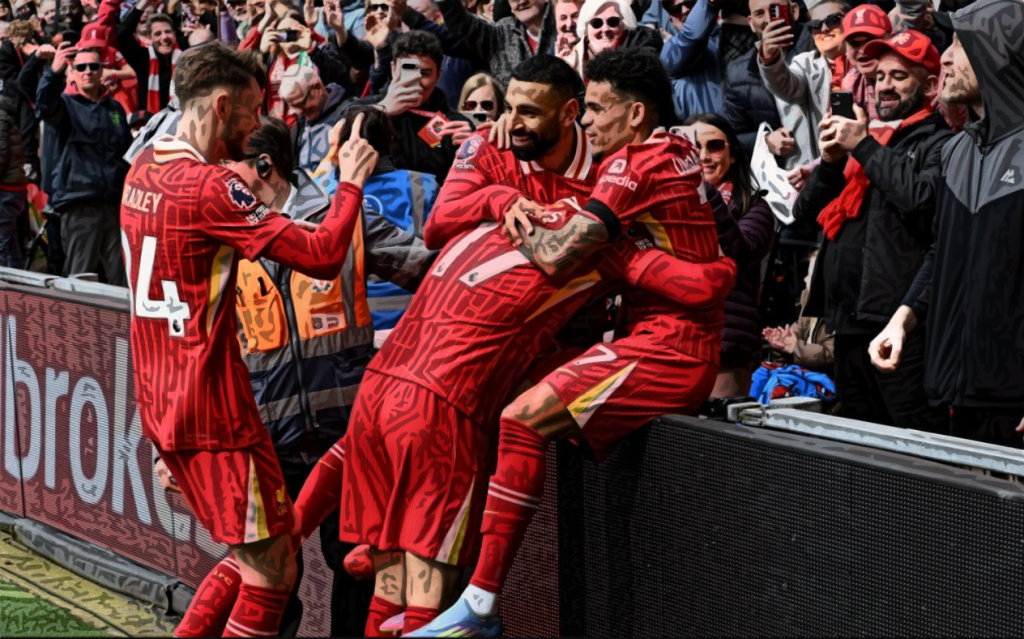
The Premier League, a relentless marathon of tactical battles and psychological tests, often hinges on a team’s capacity to navigate moments of adversity. The ability to absorb a setback and respond with unwavering resolve is a hallmark of true contenders. A recent encounter at Anfield, where Liverpool narrowly edged past a spirited West Ham United 2-1, serves as a compelling case study in this crucial aspect of elite football. While Arne Slot’s men ultimately secured three vital points in their pursuit of the league title, the match was far from a straightforward procession, offering valuable insights into both the fragility and the fortitude required at the highest level – lessons that Manchester United, a side currently wrestling with inconsistency, would be wise to heed.
The narrative of Liverpool’s season has been one of relentless pursuit, fueled by attacking dynamism and a desire to reclaim domestic supremacy. Against West Ham, the early exchanges suggested a continuation of this trend. Mohamed Salah, fresh from committing his future to the Merseyside club, played a pivotal role in the opening goal, his incisive pass carving open the West Ham defense for Luis Diaz to convert. This strike also marked a personal milestone for the Egyptian maestro, eclipsing the record for most goal involvements in a 38-game Premier League season. Anfield buzzed with anticipation, seemingly set for another comfortable victory.
However, football’s inherent unpredictability soon surfaced. As the game wore on, West Ham, under the guidance of Graham Potter, displayed a resilience of their own. Despite being largely on the back foot for significant periods, they remained organized and opportunistic. Their persistence was eventually rewarded in dramatic fashion just four minutes from time. A cross from Aaron Wan-Bissaka caused confusion in the Liverpool penalty area, with Virgil van Dijk inadvertently deflecting the ball onto Andy Robertson, who could only watch as it spun into his own net. The Anfield faithful were stunned; a seemingly assured victory had been snatched away in a moment of defensive misfortune.
This late equalizer presented a critical juncture. For many teams, conceding so late, particularly in such an unfortunate manner, could lead to a sense of deflation and an acceptance of a dropped two points. However, Liverpool’s immediate response underscored the mental fortitude that often separates champions from pretenders. Just minutes after the restart, they rallied. An Alexis Mac Allister corner found the towering presence of Virgil van Dijk, who rose above the West Ham defense to power a header into the bottom corner, restoring Liverpool’s lead in the 89th minute. This swift riposte not only secured the victory but also sent a powerful message about their resilience and unwavering determination. Even a late header from West Ham substitute Niclas Fullkrug, which struck the bar in stoppage time, could not deny Liverpool their hard-fought win.
For Manchester United, a team whose season has been punctuated by both moments of brilliance and periods of alarming vulnerability, the contrast with Liverpool’s reaction to adversity is stark. A recent outing at St. James’ Park, where they were comprehensively defeated 4-1 by Newcastle United, serves as a pertinent example. While Alejandro Garnacho did manage to restore parity in the first half following Sandro Tonali’s opener for Newcastle, the second half witnessed a capitulation rather than a spirited fightback. Harvey Barnes struck twice in quick succession, and Bruno Guimaraes added a fourth, leaving Manchester United reeling and further highlighting their susceptibility to crumbling under pressure.
The difference in how these two teams responded to conceding – Liverpool with an immediate winner, Manchester United with a concession of three further goals – speaks volumes about their respective mental strength and tactical organization in the face of setbacks. Liverpool, despite the late equalizer, maintained their focus and intensity, demonstrating a belief in their ability to find another goal. Manchester United, on the other hand, appeared to lose their shape and composure after Newcastle regained the lead early in the second half.
The role of set-pieces also emerges as a significant point of comparison. Liverpool’s winning goal originated from a corner, showcasing their effectiveness in attacking dead-ball situations. Conversely, West Ham had opportunities from set-pieces themselves, with Konstantinos Mavropanos missing a header from a James Ward-Prowse corner in the first half. This highlights the dual importance of set-pieces – not only as a potential source of goals but also as a defensive responsibility. For Manchester United, their own record in attacking and defending set-pieces has been inconsistent. Analyzing Liverpool’s well-executed corner routine and West Ham’s near miss could provide valuable insights into the nuances of organization, delivery, and execution required for success in these crucial moments.
Furthermore, the Liverpool-West Ham encounter underscored the fact that even dominant teams can face significant attacking threats. West Ham, despite ultimately losing, managed to create several clear-cut chances against Liverpool. Mohammed Kudus was particularly lively, hitting the crossbar with a delicate chip. Alisson Becker was also called upon to make crucial saves, denying Carlos Soler and Jarrod Bowen in one-on-one situations. This demonstrates that even against a strong defensive unit like Liverpool’s, well-organized and creative attacking play can yield opportunities. For Manchester United, who have at times struggled to generate consistent attacking output against top-tier opponents, learning from West Ham’s approach – their willingness to be direct, their utilization of pace and skill in wide areas, and their ability to create chances on the counter-attack – could be beneficial.
Examining the tactical approaches of both games further illuminates the contrasting responses to pressure. Liverpool, even after conceding, continued to press and probe, utilizing the width of their attack and the creativity of their midfielders to create further opportunities. Manchester United, in contrast, appeared to lack a cohesive tactical response after going behind against Newcastle. The second-half onslaught from the Magpies exposed defensive vulnerabilities and a lack of midfield control, preventing any sustained periods of pressure on the Newcastle goal.
The influence of management is also a crucial factor. Arne Slot has historically instilled a resilient mentality within the Liverpool squad, a collective belief that they can overcome setbacks. Even after the late equalizer, there was no discernible panic, just a renewed focus on finding a winner. For Manchester United, particularly during periods of transition and inconsistency, cultivating such a strong mental framework and tactical flexibility in response to adversity is paramount. The ability of the coaching staff to make timely and effective substitutions and adjustments when the game takes an unfavorable turn can be the difference between a dropped point and a hard-earned victory. In the Newcastle game, even with substitutions made by Ruben Amorim, Manchester United were unable to stem the tide of Newcastle’s attacks.
In conclusion, Liverpool’s narrow victory over West Ham, while ultimately a step closer to their title aspirations, provided a valuable lesson in resilience. The late equalizer they conceded could have derailed their momentum, but their immediate and decisive response through Virgil van Dijk’s winning goal showcased the mental fortitude and set-piece prowess that are often the hallmarks of successful teams. For Manchester United, reflecting on this game in tandem with their own chastening defeat at Newcastle offers a clear blueprint for improvement. Developing a stronger mental resilience to bounce back from conceding, honing their effectiveness in both attacking and defending set-pieces, and finding consistent attacking solutions against top opposition are crucial steps in their journey towards becoming genuine contenders. The delicate balance of responding effectively to setbacks, as so vividly demonstrated by Liverpool at Anfield, is a quality that Manchester United must strive to cultivate if they are to navigate the relentless challenges of the Premier League and ultimately achieve their ambitions. The ability to not just absorb a punch but to deliver an immediate and decisive counter-blow is the essence of a champion’s mentality, a quality Liverpool showcased and one Manchester United desperately needs to find.


