
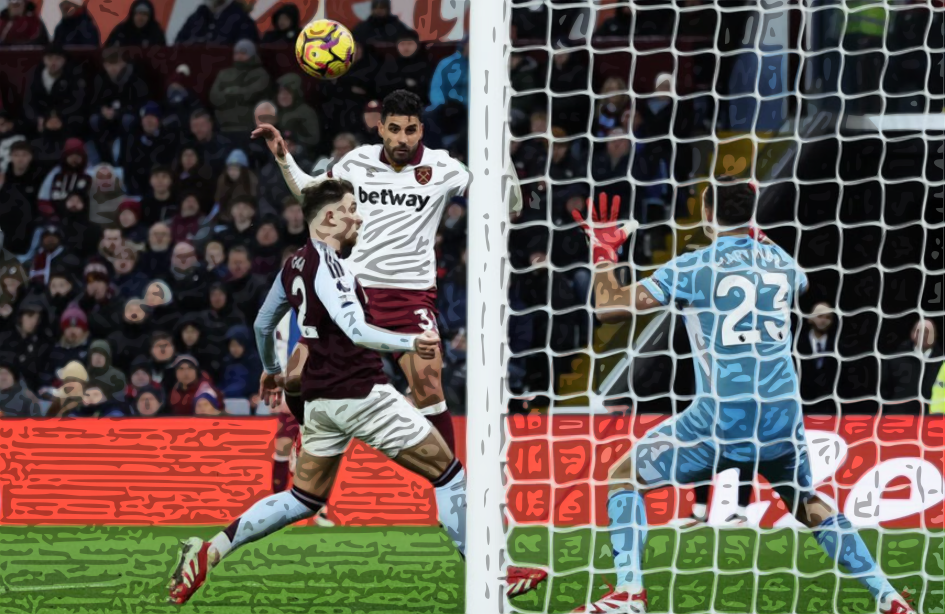
In the intricate dance of modern football, set-pieces often emerge as crucial battlegrounds, where meticulous planning and precise execution can turn the tide of a match. A recent Premier League encounter between Aston Villa and West Ham United provided a compelling case study in set-piece efficacy, highlighting how West Ham leveraged their prowess in dead-ball situations to secure a valuable draw. This article will dissect West Ham’s set-piece strategy and contrast it with Manchester United’s often lackluster record in this department, exploring the specific elements that separate success from struggle in these crucial moments of a game.
West Ham’s Set-Piece Success: A Study in Precision and Power
West Ham’s 1-1 draw with Aston Villa was a testament to their resilience and tactical adaptability, particularly in their ability to capitalize on a set-piece opportunity. This was not a match dominated by open play, but rather by moments of opportunity, and West Ham were able to seize the moment when it presented itself. The goal they scored was the result of a well executed plan, and it is an example of how set pieces can be used to gain an advantage.
- The Equalizer: Trailing by a goal, West Ham’s equalizer came via a powerful second-half header from Emerson, demonstrating the potency of a well-executed set-piece. This goal not only leveled the score but also showcased the importance of these opportunities when it comes to shifting momentum in the game.
- Álvarez’s Delivery: The goal was a product of a precise cross from Edson Álvarez, highlighting the importance of accurate delivery in set-piece situations. The cross was perfectly placed for Emerson to attack, showing that a good delivery is just as important as the movement of the players.
- Emerson’s Movement: Emerson’s movement to get into a scoring position demonstrated the need for well-timed runs and an understanding of space, as he ghosted in at the far post to nod the ball home. His ability to find space was a key factor in the goal, and it emphasizes that movement within the penalty area can make all the difference.
The Anatomy of a Set-Piece Goal: West Ham’s Blueprint
West Ham’s goal was not a stroke of luck, but a result of a well-designed set-piece strategy that can serve as a blueprint for other teams, including Manchester United. The way they approached their set-piece was with purpose, and this allowed them to take advantage of an opportunity that they created for themselves.
- The Setup: The goal originated from a wide free-kick, allowing for a delivery into the box. This setup was designed to create an opportunity for West Ham’s players to get into the penalty area, and it did so perfectly.
- The Cross: Álvarez’s cross was delivered with pace and precision, aimed toward the far post where Emerson had made his run. The quality of the delivery was key in allowing Emerson to have a good opportunity to score.
- The Finish: Emerson met the cross with a powerful header, demonstrating the importance of physicality and technique in converting set-piece chances. The way that Emerson headed the ball was a direct result of his technique, and it allowed him to guide the ball into the net.
Height and Physicality: West Ham’s Advantage
West Ham’s success in set-piece situations is partly due to their height and physicality, which they utilize to great effect, especially in the penalty area. They also use these characteristics to their advantage when it comes to defending set-pieces from the opponent.
- Aerial Threat: The team often uses players who excel in the air, creating an aerial threat that makes them dangerous from corners and free-kicks. They are able to win headers in key areas, and this allows them to both score and defend effectively.
- Physical Presence: West Ham’s players often show their physical presence in the box, winning battles for position and making it difficult for opponents to defend against their attacks. Their physicality makes them a difficult team to play against in set-piece situations, and it is a key element of their game.
- Defensive Strength: This physical presence is not only beneficial in attack but is also important in defending their own goal from set-pieces. Their height and strength makes it difficult for their opponents to score from these opportunities.
Sticking to the Task: Set-Pieces as a Strategy
West Ham’s ability to stick to their task and secure a point through a set-piece emphasizes the importance of these opportunities as an integral part of a team’s overall strategy. Set pieces should not be an afterthought, they should be a primary focus of training, and West Ham’s success proves this.
- Resilience: The team’s goal shows how set-pieces can be a valuable tool to gain a point when a team is not able to find a goal through open play. Their ability to stick to the task allowed them to be ready for the opportunity when it arose.
- Tactical Acumen: West Ham’s goal was a demonstration of tactical acumen in the delivery and the movement, all of which was specifically designed to get the goal. They planned the set-piece and it worked as they intended.
- Strategic Value: Set-pieces can also be a way to take advantage of an opponent’s weakness, and their overall strategic value should not be underestimated. The ability to convert set-pieces into goals gives the team an advantage, and it is a key aspect of any successful team.
Manchester United’s Set-Piece Struggles: A Stark Contrast
In stark contrast to West Ham, Manchester United have often struggled to make an impact from set-pieces, highlighting a potential area for improvement, especially when looking at the team’s defensive record. They often struggle to both score and defend set-pieces, and this has been a major contributing factor in their lack of success.
- Lack of Goals: United often fail to convert their own set-pieces into goals. This can be attributed to several factors, such as poor delivery, lack of movement, and a lack of physicality.
- Defensive Weakness: They also have struggled to defend against set-pieces. They often concede goals from situations that they should be able to defend against, showing a weakness in their organization and communication.
- Missed Opportunities: This inability to take advantage of these opportunities has resulted in the team dropping points in matches that they should be winning. A lack of goal scoring opportunities from set-pieces is one thing, but a lack of ability to defend them is another.
The Contrast: Manchester United and West Ham
The difference in set-piece efficiency between West Ham and Manchester United is clear. While West Ham uses these situations to their advantage, Manchester United often struggles to create or defend against them. This difference highlights a key area of weakness for United that needs to be addressed, and it is costing them dearly.
- West Ham’s Strength: West Ham approaches set-pieces with a specific goal in mind, and they have the players to make it work. Their success in this area shows that these situations are not simply a matter of luck, they can be planned for and practiced effectively.
- United’s Deficiency: Manchester United’s struggles in this area show that there is a lack of focus, planning, and execution when it comes to set-pieces. This shows that they are not approaching these situations with the same level of intensity or purpose.
- A Need for Change: The contrast in set-piece performances highlights a clear area where Manchester United can improve by looking at how a team like West Ham has been successful, and it is something that needs to be addressed quickly if the team is to be successful.
Lessons for Manchester United: Developing Set-Piece Prowess
Manchester United can learn a lot from West Ham’s approach, and they must develop a more effective set-piece strategy in order to be competitive. This requires a multi-faceted approach that addresses both their attacking and defending of set-pieces.
- Specific Training: Manchester United must prioritize specific set-piece training to improve both their offensive and defensive capabilities. They must practice a variety of delivery options, and they must ensure that the movement of the players in the penalty area is precise and purposeful.
- Accurate Delivery: Players who can deliver quality crosses and free-kicks need to be identified and given more responsibility in these situations. A consistent delivery will make the movements of the players in the penalty area more purposeful.
- Physicality and Positioning: They must also work on the players’ physicality and positioning, both in attack and defense. The players need to learn how to win their headers, and how to move in the penalty area in order to take advantage of set-piece opportunities.
- Tactical Planning: Set-pieces require tactical planning, as a well-designed plan can make all the difference. Manchester United’s set-piece strategy must be designed to take advantage of the weaknesses of their opponents, and they need to be flexible in how they approach these situations.
- Managerial Influence: The manager must emphasize the importance of set-pieces and make them a priority in training, as his tactical influence can be the difference between success and failure. He also needs to communicate the importance of these opportunities to the players, so that they approach them with purpose and focus.
Conclusion: The Undervalued Art of Set-Pieces
West Ham’s success in set-pieces showcases their tactical proficiency and the strategic value of these situations, demonstrating how they can be used effectively to secure valuable points. They were able to use their set-piece goal to gain a valuable point in the match against Aston Villa, highlighting how a well designed plan can change the result of a match. In contrast, Manchester United’s struggles in this department show a lack of focus and precision, as they often concede goals from set-pieces and fail to make an impact when they have the opportunity. By learning from teams like West Ham, Manchester United can enhance their set-piece strategy, becoming a more well rounded team that is capable of scoring and defending at a higher level.


